Category Archives: Cool Season Crops

Seed Inventory | Seeds to Order Now to Start Soon

The key to tasty salads is incorporating a mix of lettuce varieties. The vertical hydroponic Tower Garden is perfect for packing in 28 plants within a 2.5′ square footprint. This article focuses on spring planting, but you could grow any of these plants year-round if you have purchased the light attachment for your Tower Garden keeping the indoor environment around 70ºF.

There are certain greens that do really well in colder weather and can grow in early spring after the danger of frost has passed. Here is zone 7b, we will be starting greens the first week of March to be ready to go outside the last week of March. (Will use a Weather Protection Blanket each night until Frost Date of April 12.) It’s better to not have to store seeds for longer than a year or two, so we tend to purchase from this seed provider (Seeds Now), because of the smaller quantities and lower prices. The lower cost of seeds also enables us to try more varieties to see what we like the best.
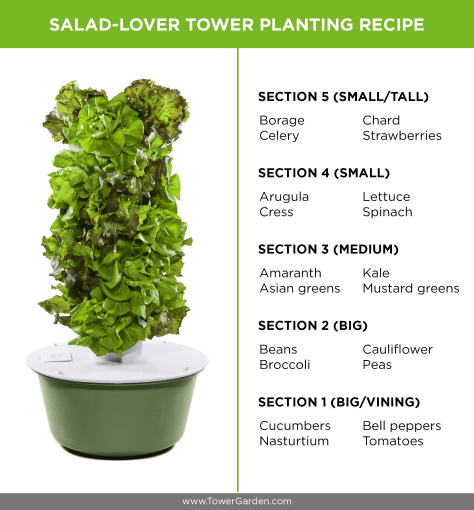
Salad Tower Garden Tower Planting Schematic

Here is a list of greens to inspire…  consider starting from seed soon!

  • Arugula – Classic Roquette Arugula by Seeds Now
    Arugula can usually be harvested as early as one month after planting. Arugula is an easy-to-grow green using any hydroponic setup you have.  The leaves of the Arugula plant add a tangy/peppery flavor to any meal. We recommend picking the outer leaves when plant is still young (leaves about 3″ long) and it will continue to grow throughout the season.
    Approx. 150 seeds for $1.99
    | order seeds |


  • Chives – GarlicGarlic Chives by Seed Now
    Also known as Garlic Chives.  A perennial plant that grows narrow, grass-like leaves that have a mild onion-like flavor. Chives are rich in vitamins A and C, contain trace amounts of sulfur, and are rich in calcium and iron. Used for many culinary creations. The plant will grow to about 12″ tall and is best suited for the top row of the Tower Garden. Once established, you can trim the entire bunch to about 3″ and the chives will regrow (cut and come again).
    Approx. 115 seeds for $1.99
    | order seeds |


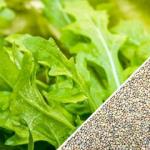
  • Endive – Green CurledEndive by Seeds Now
    Endive is a healthy and delicious leafy green and produces dark green curly leaves with large tender crisp ribs. Excellent on salads and sandwiches. Rich in many vitamins and minerals, especially in folate and vitamins A and K, and is high in fiber. Extremely easy to grow using any hydroponic setup you have. Plant this variety all-year-round using hydroponics and grow lights.
    Approx. 100 seeds for $0.99
    | order seeds |


  • Kale – LacinatoKale-Lacinato-SN
    Old Italian heirloom, rather primitive open kale with blue-green strap leaves that are 3″ wide by 10-18″ long. Perfect for making Kale Chips! Extremely easy to grow using any hydroponic setup you have. The leaves of this extremely winter-hardy variety become sweeter after a hard frost or harvest leaves when young and tender. Delicious and tender when stir-fried or steamed.
    Approx. 55 seeds for $1.99
    | order seeds |


  • Kale – Red Russian Kale-Red-Russian-SN
    Stems are purple with deep gray-green leaves.   The plants mature medium-tall and leaves are tender compared to other kale varieties. Ideal for salads and light cooking.  Extremely easy to grow using any hydroponic setup you have.
    Approx. 50 seeds for $0.99
    | order seeds |


  • Lettuce – All Year Round All Year Round Variety of Lettuce
    As its name suggests, this is a lettuce that can be gown throughout the year. In even some of the the coldest areas across the country, this variety can be grown with some protection with a cloche or cold frame in the cooler months.
    Approx. 200 seeds for $1.99
    | order seeds |


  • Lettuce – Gourmet/Mesclun MixGourmet Mesclun Mix Lettuce
    A mixture of favorite lettuce seed varieties from across the spectrum of lettuce types.  Plant heavy and start harvest early for young for baby greens then allow some to grow on for plenty of variety for salads.  A great way to get a lot out of little space.  Perfect for container gardening.
    Approx. 200 seeds for $1.99
    order seeds |


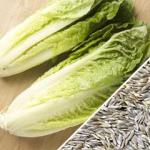
  • Lettuce – Romaine, ClassicLettuce-Romaine-Classic-SN
    Large, upright, full-bodied heads with dark-green, slightly savoyed leaves that are mild and sweet. Plant reaches about 10 inches tall. Midribs are crunchy and juicy.  Because of their higher chlorophyll content, romaine lettuces are among the most nutritious of all lettuces.
    Approx. 135 seeds for $1.99
    | order seeds |


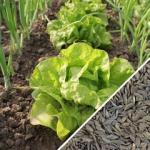
  • Lettuce – Salad Bowl, GreenLettuce-Salad-Bowl-Green-SN
    The Green Salad Bowl Mix is a really easy-to-grow lettuce variety. Extremely flavorful green leafs. Continues to grow as picked. As outer leaves are picked, inner leaves keep growing. Excellent addition for salads and garnishes. A great variety for many gourmet chefs around the world.
    Approx. 150 seeds for $1.99
    | order seeds |


  • Lettuce – Salad Bowl, RedLettuce-Salad-Bowl-Red-SN
    The Red Salad Bowl Mix is a really easy-to-grow lettuce variety. Extremely flavorful red leafs. Continues to grow as picked. As outer leaves are picked, inner leaves keep growing. Excellent addition for salads and garnishes. A great variety for many gourmet chefs around the world.
    Approx. 150 seeds for $1.99
    | order seeds |


  • Lettuce – Little Gem Lettuce-Little-Gem-SN
    Crisp & refreshing lettuce variety.  Sweet and crunchy. The leaves of this particular lettuce makes it idea for use in wraps and hors d’oeuvres. Easy to grow in compact spaces and smaller containers. A great variety for many gourmet chefs around the world.
    Approx. 200 seeds for $0.99
    order seeds |


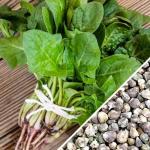
  • Corn Salad (Mache), DutchCorn Salad Mache Dutch
    Corn Salad has a delicate flavor, similar to a butterhead lettuce. It is quite hardy and requires very little care while remaining practically free of pests & disease. Corn salad is also known for growing vigorously in almost any soil!  We think Corn Salad tastes best right out of the garden with a light drizzle of olive oil and a squeeze of fresh lemon. Once you try this cold-hardy green, you’ll be sure to make it a staple in your fall/winter gardens every year.
    Approx. 200 seeds for $0.99
    order seeds |


  • Swiss Chard – Hot Pink Swiss-Chard-Hot-Pink-seed-SN
    The Pink Swiss Chard produces excellent yields of dark green shiny leaves with magenta/hot pink stalks and veins. Excellent for salads, juicing, and/or steamed with others greens. Extremely healthy and easy to grow.
    Approx. 25 seeds for $0.99
    | order seeds |


  • Swiss Chard – Gourmet RainbowSwiss-Chard-Rainbow-Mix-SN
    A heirloom variety from Australia. The Rainbow Swiss Chard is a popular plant that  produces some of the most amazing looking swiss chard leaves in shades of red, orange, purple, yellow, and white. Perfect for salads or steamed greens. One of this years most popular varieties to grow. Extremely healthy.
    Approx. 25 seeds for $1.99
    | order seeds |


  • Purslane, Green (herb)Purslane Herb for Salads
    Used in salads and can be cooked like spinach, purslane has a lemony-twang. Remove leaves from stalk and toss into your salad. Purslane contains more omega 3 fatty acids than any other plant source in the solar system, and an extraordinary amount for a plant, some 8.5 mg for every gram of weight.  It has vitamin A, B, C and E. In fact, it has six times more E than spinach! It also has seven times of beta carotene than carrots as well as contains magnesium, calcium, potassium, folate, lithium, iron and is 2.5% protein. You should grow this plant and toss it into your salads! Some even sauté it with onion and chili (green) and scrambled eggs.
    Approx. 100 seeds for $1.99
    | order seeds|


  • Radicchio, Red ClassicRadicchio Red Endive
    Used in salads radicchio grows from orange to grapefruit size and easy to peel, the smooth, crisp leaves to offer a bitter flavor with a hint of spice. 

    Approx. 100 seeds for $1.99
    | order seeds|


  • Don’t forget to have plant markers/labels on hand as well!
    Pack of 10 for $0.99
    Pack of 100 for $8.99
    Use drop down option on ordering page to select quantity desired.
    | order labels/markers |


Happy planning and be sure to show us your yummy salad creations in 4-6 weeks when you’re enjoying them by tagging us at #GYHG!

— Erin


New to ordering from Seeds Now?
Click to get an exclusive
Grow Your Health Gardening
discount code!

01-17-15-12-19-46_XQHZQFUH2BGGZPAEO4Q7O2

Growing your own baby spinach in a hydroponic or aeroponic system

Why you should be growing your own spinach instead of buying from the grocery store or big-box retailer:

If you follow EWG’s 2019 Shopper’s Guide to Pesticides in Produce™ report that comes out around March every year, you’ve probably heard that conventionally grown spinach has more pesticide residues by weight than all other produce tested, with three-fourths of samples tested contaminated with a neurotoxic bug killer banned from use on food crops in Europe. It has moved from being ranked 8th on EWG’s “Dirty Dozen” list to number two in containing the most pesticides in fruits and vegetables presently being sold in supermarkets and grocery stores around the United States.  The USDA has also detected pesticides on frozen and canned spinach, which suggests that washing and cooking reduces, but does not eliminate pesticide levels. (You can read the full findings on spinach in a press release here.)

As you may already be aware, Spinach is a great source of vitamin A, folate and vitamin C and a good source of vitamin E and potassium. But for your body to receive all these nutritional benefits, it is essential to consume the spinach as quickly as possible following harvest. Baby spinach leaves have a very high respiration rate and studies have shown that the temp these leaves are stored at plays a key role. For example, one Hort Technology study found that Baby spinach leaves (harvested 36 days after planting) experienced significant losses in nutritional benefit. Both total antioxidant activities and Vitamin C content showed a decrease after 6 days when stored at 39.2°F, whereas the total antioxidant activities and vitamin C for leaves stored at 71.6ºF decreased immediately after 2 days.  The concentration of magnesium (Mg), zinc (Zn), and iron (Fe) for example, declined after 8 days of storage at 39.2ºF, while at 71.6ºF they declined after 2 days of storage. Total phenolic compounds gradually decreased in samples stored at 39.2ºF whereas, samples stored at 71.6ºF showed a rapid decrease after 4 days. Results demonstrated that quality of baby spinach deteriorates as storage time and temperature increase. (You can read more about the study here.)

Research shows that nutritional benefits degrade with every hour following harvest, so the sooner you can consume your food after it’s been harvested, the more nutrients your body will receive from the spinach.

Degradation happens not only with temperatures, but you also need to factor how long it takes to move the spinach from harvest, transportation, to the product sitting on the shelf to be purchased at the store. It is estimated that it takes about 10-days for produce to be shipped from where it is grown to get to the consumer’s plate. Ten days!!! And you, the consumer are relying heavily on whether or not that spinach was kept at a constant 39.2ºF or lower in the post-harvest transportation and storage process. Could the reason be it is cheap at the store is it is an inferior product compared to what can be grown in your own home?

With a little know-how, you don’t have to settle for sub-par spinach and greens. You can grow in your own home and harvest when you’re ready to consume your spinach and greens for optimal nutritional benefit.

For the purposes of this article, we are writing it with aeroponic / hydroponic Tower Garden by JuicePlus+™ growers in mind for either indoors or outdoors growing spinach in their own home of on a backyard deck, but the info will also work in related hydroponic systems so long as the environment fits the plant’s needs.

Growing your own baby spinach will offer you the peace of mind and gain self-assurance knowing that your home-grown baby spinach is clean. You will also be able to harvest for maximum nutritional benefit when the plant is at it’s peak nutritionally going directly from your Tower Garden to your dinner table in a matter of minutes!


Growing your own spinach:

To grow your spinach, here are some things to keep in mind with what spinach needs to grow successfully. Depending on the time of year and whether you are growing inside or outside are key factors to consider. Spinach is a COOL SEASON crop, so you’ll want to avoid extreme heat which can cause it to bolt (go to seed and become bitter).
Monnopa Spinach Seed

Choosing your spinach variety:

Plant from seed making sure that you have new seed as older seed has a greater difficulty in germinating. Those varieties that are most suitable for the Tower Garden are recommended as follows:

Spinach: Monnopa Heirloom Low-Acid Spinach (Very Rare)
(100% Heirloom/Non-Hybrid/Non-GMO buy seed )Spinach_-_America_seeds_1024x1024

  • Monnopa Spinach is a perfect choice for those who need low-acid foods in their diet.
    – Extremely delicious and one of the most sweetest spinach varieties you can grow in your Tower Garden or hydroponic system
    – Very easy to grow.
  • Days to Maturity | 45-60 days

Spinach: Noble Giant
(100% Heirloom/Non-Hybrid/Non-GMO buy seed )Spinach variety Noble Giant for Tower Garden

  • Noble Giant Spinach is heavy, glossy, dark green plant with leaves that are heavily savoyed and crumpled.
    – Extremely delicious and one of the most popular spinach varieties you can grow in your Tower Garden or hydroponic system
    – Very easy to grow.
  • Days to Maturity | 45 days

Spinach: New Zealand
(100% Heirloom/Non-Hybrid/Non-GMO buy seed )Spinach_-_New_Zealand_seeds_main_1024x1024

  • New Zealand Spinach seeds will produce very flavorful medium triangular-shaped green spinach leaves. New Zealand Spinach is a large growing plant.
  • This is one of the few spinach varieties that produces continuously all year, from spring to fall. The more you cut and use the more it will continue to grow.
  • And … Unlike the other spinach varieties, the New Zealand is one that can survive through the hot summers.
  • Days to Maturity | 75 days

Spinach: Bloomsdale
(100% Heirloom/Non-Hybrid/Non-GMO buy seed )

Spinach_-_Bloomsdale_seeds_1024x1024

  • Bloomsdale Spinach will produce heavy, glossy, dark green leaves.
    – Excellent flavor
    – Extremely easy to grow
    – Large, curly dark green leaves
    – Nice sweet taste
  • Days to Maturity | 45 days

Spinach: America
(100% Heirloom/Non-Hybrid/Non-GMO buy seed )

Spinach_-_America_seeds_1024x1024

  • America Spinach will produce a beautiful dark green plant in only 40 days. Smaller plant stature.
    – Excellent flavor.
    – Extremely easy to grow.
    – Grows best during the cooler months.
  • Days to Maturity | 40 days

Spinach: Matador Viking
(100% Heirloom/Non-Hybrid/Non-GMO buy seed )

Spinach_-_Matador_Viking_seeds_main_1024x1024

  • Matador Viking Spinach will produce beautiful large and smooth dark green spinach leaves in only 45 days.
    – Excellent flavor.
    – Full of nutrients.
    – Extremely easy to grow.
    – Grows best during the cooler months.
    – Grows really well in containers and other small spaces.
  • Days to Maturity | 45 days

Spinach: Winter Giant
(100% Heirloom/Non-Hybrid/Non-GMO buy seed )

Spinach_-_Winter_Giant_seeds_1024x1024

  • Winter Giant Spinach seeds will produce very flavorful large green spinach leaves.
  • Winter Giant is a variety of Spinach which is a member of the Spinacia family. It is a Vegetable and is treated mainly as a Annual, this means that it grows best over the course of a single year. source: myfolia
  • Known for growing to a height of appx. 2 feet. 
  • Days to Maturity | 55 days

Choose slow-bolting varieties for later spring plantings. Disease resistance is more important for fall crops. Savoyed (curly) leaves are handsome and keep better. New Zealand spinach and Malabar spinach are warm-season greens similar to spinach, but different species.

Common spinach cannot grow in midsummer. (For a summer harvest, try New Zealand Spinach or Malabar Spinach, two similar leafy greens that are more heat tolerant.) — Old Farmer’s Almanac

If you’re later in the season and have missed your seed start date, you can always purchase spinach starts from an area hydroponic grower. We recommend driving to a local grower to pick-up any seedlings vs. shipping (remember shipping containers can be extremely warm or extremely cold which can damage tender young plants.)

How many plants should you plant:

It is estimated that you will want ideally 15 plants per person. For a family of four, you will want to plant an entire Tower Garden with one extension for 28 plants and keep two spinach plants per rock wool making for 56 plants total.

Starting your spinach from seed:

Cold stratification: One to three-weeks prior to planting some growers will store seeds in the refrigerator. It has the effect of hardening them and may lead to a healthier plant.

If you’re planting outdoors, you’ll want to pay attention to your frost and freeze dates in your area. You can find these dates doing a google search or here. (If planting indoors, you can ignore the next paragraph and skip down to the next paragraph as you can plant spinach any time of the year using the Tower Garden LED Indoor Lights with the assumption that you will keep your home in the temperature range spinach requires.)

Having trouble getting your spinach seed to germinate? Try this pro tip: place seed in a plastic container in between two wetted paper towels and seal by placing lid on top of container. Check your seeds in 7-10 days and if the seed is viable, you will see some seeds with a root breaking out of the seed casing. You’ll want to move this germinated seed into a wet cube of rock wool and place a few bits of vermiculite around the germinated seed to retain moisture. DO NOT place on a heat mat. Place under bright artificial grow lights while keeping rock wool and vermiculite moist, but not drenched/soaked. Make sure to have a fan in the room for air movement as well as this will help to control humidity levels and stave off any fungal disease from setting into you seedlings.

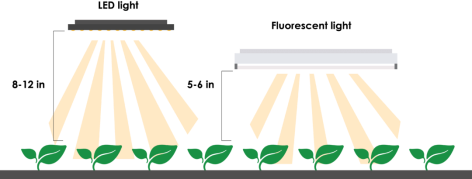
Outdoor planting in a hydroponics system: If planting in the spring, you will want to start your seeds indoors or in a greenhouse so that your seedling start will be about four to six weeks old by the time your spring frost date rolls around. If planting in the fall, you’ll want to factor in your harvest date range and count backwards from your frost date. Note: in the fall, you will want to expose your seedlings to UV rays without excessive heat. Spinach likes to live around 45º-75º and may fail to germinate if too warm. For example, in the southeast, you will want to select a variety that has a short maturation date for a fall planting and use a UV light system of some sort to grow your seedlings indoors keeping the light source 8″-12″ if LEDs and 5″-6″ away from seedlings if fluorescent lighting.

LED-vs-Fluorescent1-bigger-1080x410

How many seeds to plant per rock wool: We recommend planting about 5 seeds per rock wool cube. Spinach typically germinates within 1–2 weeks. Be sure to use seed that is packaged for the current growing season as it will aide your ability to germinate the seeds. You can always remove any excess seedlings as the plants mature if you are concerned about crowding. Our philosophy is start out with more and thin down as needed (plus the seedlings will be healthy for you to eat as micro-greens).

How much nutrients you should give your seedlings:  Water daily with 1/4 strength nutrient solution until the seeds germinate and sprout. After sprouting use 1/2 strength solution.

Thinning out your seedling starts: As the seeds germinate and grow, you will want to pull (or also called “thin out”) the weaker seedlings from the rock wool. (Remember, this is not a wasted plant — you can try to replant in soil or simply enjoy eating it as a microgreen.)  You will want to leave leave 1-2 plants per rock wool to mature.

Transplanting your seedlings into your hydroponic system:  Seedlings should be ready to transplant to your Tower Garden or hydroponic system about 2–3 weeks after sprouting. Seedlings plants should be about 2-3 inches tall, with 3-4 true leaves, before they are ready to leave the nest and enter into the hydroponic / aeroponic Tower Garden or other related system.

Finally, remember that spinach plantings should be staggered in roughly 2-3 week intervals in order to ensure a continuous harvest. If doing a spring planting, your growing season will be longer than a fall planting. You can extend your fall outdoor planting season by adding a professional grade heater to your Tower Garden reservoir keeping water temps in the 70º F range for the root zone to continue to uptake nutrients — just be sure to cover your Tower Garden outside with a weather protection blanket like this when freeze warnings appear.


Nutrient levels for optimal growth throughout the growing season for spinach:

Nutrients:
EC:
1.5 mS cm-1  (1.2 for warmer temps)
(We recommend Tower Tonic Mineral Blend™ for a well-balanced nutrient solution to feed your plants the proper N-K-P and micro-nutrients. You can purchase a 1 gallon set of Part A and Part B here.)

PPM: 1260-1610
(We recommend Tower Tonic Mineral Blend™ for a well-balanced nutrient solution to feed your plants the proper N-K-P and micro-nutrients. You can purchase a 1 gallon set of Part A and Part B here.)

pH:  5.8-6.2
(pH is essential to help the plant uptake nutrients.)

Light: (Amount of sun or light exposure throughout the day)
Hydroponic spinach should get between 10 and 14 hours of light per day.

Spinach Temp Tips:
(Root zone temp is essential to help the plant uptake nutrients)

Maximum Temp 75º Degrees Fahrenheit

Optimal Day Cycle Temp  65º – 70º Fahrenheit

Optimal Night Cycle Temp  60º – 65º Fahrenheit

Seed Storage  40º to 70º degrees Fahrenheit

Germination  60º to 75º degrees Fahrenheit


Harvesting your spinach:

Make a note of how many days to maturation on the variety of spinach you are planting (found on your seed packet) and mark your calendar. When your plants have reached maturation, take a sanitized clean pair of hand trimmers or scissors and cut the outer older leaves of your spinach plant, leaving three center leaves to continue to grow. The plant will continue to produce leaves for you throughout the growing season. Simply return and harvest the outer leaves leaving 3-4 center leaves each time for multiple harvests. Ideally, your spinach should be eaten within a few hours of harvest; however, if storage is necessary, the correct conditions to prolong shelf life are rapid cooling down to 34°F and 95-98 per cent humidity (i.e inside a plastic bag).
Monnopa Spinach Seed

How to store spinach that is not consumed right away:

If you have more spinach producing faster than you can eat, there are a couple of options: dehydrating or freezing.  To dehydrate your spinach leaves, place on a dehydrator rack at 110º F for 12-24 hours. When the leaves are crunchy (you can break them in half), remove from the dehydrator and place in a tightly sealed pouch or Mason jar with an oxygen absorber. Dehydrated spinach can be used in soups and ground into a powder to add to pestos for additional nutrients. You can also freeze your crop in an air-tight bag or container and use in smoothies or defrost and use in recipes that may call for spinach. The benefit here is that a) you know what is on your spinach (no pesticides!) and b) your ability to harvest and process immediately vastly improves nutritional value of the spinach you’re consuming.

Let us know if you have any questions in the comments below. And happy growing!