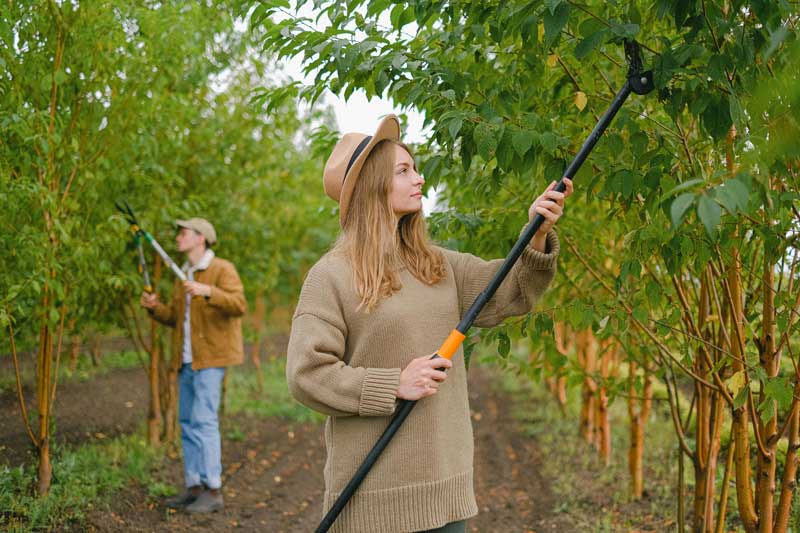
Use the following chart to help jog your memory on when it is best to prune either a fruit tree or a bush. We will come back to this list periodically to add to it as we have updates. And after you have pruned, be ready for when blooms emerge as spring is an ideal time to fertilize once you see new growth.
Fruit Trees:
Apple
Winter or early spring
Train tree for low head and prune moderately. Keep the center of the tree open with main branches well-spaced around the tree. Avoid sharp V-shaped crotches.
Cherry
Winter or early spring
Prune moderately, cut back slightly the most vigorous shoots.
Citrus
Spring after risk of freeze has passed,
Prune after risk of freeze has passed, but well in advance of summer heat. Water sprouts, a.k.a. “suckers”, emerge frequently, especially the first few years of the tree’s life. It’s best to remove suckers as they appear, otherwise, they take energy from the tree. The thorns also make harvest difficult. If the suckers do produce fruit, it is usually bitter and unpalatable.
Peach
Early spring before buds
Prune vigorously removing one-half of the previous year’s growth keeping the tree headed low and well thinned out.
Plum
Early spring
Remove dead and diseased branches, keep tree shaped up by cutting back rank growth. Prune moderately.
Quince
Early spring
Cut back young trees to form low, open head. Little pruning of older trees is required except to remove dead and weak growth and keep airflow.
Flowering Japanese Magnolia
Early spring
Before buds open, trim off side limbs that cross another limb. Keep center of tree open for airflow and birds will nest in it.
Fruit Bushes, Flowering Bushes, and Vining Plants
Blackberry
After bearing and summer
Remove at ground canes that bore last crop.In summer, but back new shoots 3.5′ high.
Boxwood
Early spring
Trim and shape before new growth occurs.
Blueberry
Winter while plants are dormant
Blueberries only grow on branches that are at least one year old, but the older the branch, the fewer the berries produced. You must prune the bushes so that they provide enough new growth for blueberry production the following year.
Raspberry
After bearing and summer
Remove at the ground in fall canes which bore last crop. In summer, head back new canes 20 ” to 22″ inches high.
Currant
Early spring
Remove old unfruitful growth and encourage new shoots.
Gardenia
Right after blooms have faded
Pruning your gardenia every other year typically keeps the size manageable. Gardenia blooms on new growth, so pruning after bloom cycle is ideal.
Gooseberry
Early spring
Same as currant—cut back shoots at 12″ inch and side shoots to two buds.
Grape
Late winter or early spring
Requires heavy pruning of old wood to encourage new bearing wood. Remove all old branches back to main vine. Cut back the previous year’s new growth to four buds.
Hydrangea
Early spring
Hills of Snow variety cut back to ground. Other varieties: remove dead and weak growth, cut old flowering stems back
Elderberry
After fruiting (Sept/Oct)
Prune severely. Remove one-half of season’s growth on established plants.
Roses, Tea, Hybrid, Perpetual
Early spring
Cut away all dead and weak growth and shorten all remaining branches or canes to four buds for weak growers and five buds for vigorous varieties.
Roses, Climbing
After flowering
Cut away all dead and weak growth and shorten all remaining branches or canes to four buds for weak growers and five buds for vigorous varieties.
“The best food in the world starts in the garden and ends on your plate, perhaps after a comfortingly stop in a well-stocked pantry or freezer. It never knows the back of a truck or the inside of a factory, and it holds no chemical or genetic secrets. Eating it feels comfortable and good.”
What is it about growing and preserving your own food that makes it worth the time and trouble? Here are 18 common traits we’ve observed of pantry gardeners… See how many you can identify with!
You want to know exactly what’s in the food you’re eating and feeding those you love. You have been educated in the effects of chemicals on foods and understand you can’t always simply “wash off” the pesticides. Everything that comes into contact with the commercially grown plant and soil is taken up by the plant affecting the nutrition as soils wane and become poorer with every season of use.
You understand that “organic” still means pesticides may have been applied to the plant you’re about to eat and “some” pesticides is still too much. You want to feel confident that the food you eat and feed to your family is the best clean nutritious food you can find.
You understand that plants grown for the grocery store are grown for their transportability and shelf life, not for nutritional value or flavor as the primary goal. Growing your own produce from seed gives you the advantage of picking what you’re going to eat at its peak ripeness meaning it will have all the nutritional benefits you are desiring. Further, you can quickly process the plant at its peak by harvesting, cleaning, and processing it either to eat right away or put into long term storage. In either case, you’ll be locking in optimal nutrition for your body.
You understand that growing your own food is investing in your own personal health and the health of those you care for on a daily basis. The activity of gardening is good for your mind and body according to research and personal experience.
You don’t have a consumer mindset where you only buy and live in the moment… instead, you think about your future needs and make an effort to have something on hand in the event you cannot find what you enjoy eating. This mindset of thinking long-range not only gives you peace of mind that you have some food security when tough times come. Those of us that had grandparents that lived through the depression era, now understand why they took the time to plant a garden and can food. Food security can be empowering and peace-giving.
It feels good knowing that you won’t be the cause for more packaging and plastic to be thrown away. Eliminating the need to purchase items from the store means you are creating a smaller carbon footprint on the need to rely on packaged goods.
You have practiced persistence and are able to stick with a task over a period of time in order to achieve the end goal (often referred to as delayed gratification.) You know with a little bit of effort, consistently over time, you can achieve anything — including a stocked pantry full of nutritious food you have grown.
You understand that investing in the right tools to grow food upfront will have a savings effect over time. Your homegrown food will outpace inflation in savings — it will cost less than store bought food (especially if you’re using a hydroponic Tower Garden.)
You connect with family history through gardening and preserving teaching the next generation through example these simply lessons of healthy living. Maybe it’s making your grandmother’s apply pie or your mama’s fresh basil pesto — these foods have a strong connection to your past and good memories. In sharing that with your children, you pass along these gifts.
You know that home grown herbs that are dried immediately after harvesting out-surpass anything you can buy in the store when it comes to flavor and nutrients. Store bought seasonings sit on the shelf and lose flavonoids when they are crushed. By the time they are used in your cooking, the flavor has diminished. Drying your own herbs and keeping them in leaf form as much as possible keeps the flavonoids in tack and maintains a superior seasoning when you go to crush them and use them in your cooking.
You find that maintaining your own food supply helps to connect you more deeply to the earth and the seasons of life. Watching a plant grow from seed to harvest or even to produce seed to collect gives you a deeper connection to living life to the fullest as you appreciate the cycle of life.
You feel empowered to try something new and aren’t afraid to risk failing. You know that nothing is gained by not trying, so you’re willing to put yourself out there and explore new things in order to gain understanding.
You have a generous nature in that you freely share what you have grown and preserved either through sharing of a meal together or in helping out a neighbor or loved one when they are grieving or in need.
In selecting plants intentionally for their usefulness, you are able to gain the benefit of harvesting herbs in particular for medicinal uses to bolster your immune system. Homegrown herbs with medicinal benefits give one access to health care no matter your age or demographic.
In preparing items for your pantry, the time it takes to go to the store to purchase those items (as well as the cost associated with that grocery run) saves you time in making meals at home. You just walk over to the pantry shelf or go outside to the garden and “shop” from your own aisle.
You know the importance of being mindful of salt and sugar in your food as it affects your arteries and heart. Store-bought options and eating out expose you to higher than normal recommended levels of sodium and sugar. Plus, aluminum cans leech aluminum into contents (food) over time. Storing your own food puts you in control of how much salt or sugar is put into whatever you are preserving.
You like working smarter, not harder. If you have an indoor Tower Garden with grow lights, you have total freedom to grow food 3x bigger and 3x faster using 98% LESS water than traditional gardens 365 days a year indoors. You bask 24/7 in your ability to have food freedom no matter what the weather or pest pressure happens to be outside.
You are resourceful and don’t waste anything—you are the top recycler in your neighborhood. You know that some of the things we consume can be used to feed your soil and garden. The whole chicken you just ate can be used to make bone broth. The bones can be dried and then put into ACV (Apple Cider Vinegar) for four weeks to extract calcium for a shelf stable fertilizer that can then be added to water and used as a foliar spray or soil drench. Remove the bones from your ACV and re-dry the bones and they can be crushed down into a powder to add into your soil. No need to go out and buy bone meal or calcium spray. You literally can make your own fertilizers.
I love lavender. It’s one of my go-to essential oils and a good lavender foot soak with salt is THE BEST! So, when my husband surprised me with a special mother/daughter lavender farm tour and workshop in Thomson, Georgia I was thrilled! Of course, it is more fun to travel as a family so I asked if he and one of our sons could tag along.
When we arrived at our hotel Friday evening, we were given two wonderful gift bags full of information on what we could do during our stay as well as treats and Thomson, GA swag (like a fun tumbler, luggage tags, vinyl stickers, and a drink cozy) and a couple of gift cards to use in the area (which we were delighted to take advantage of to stretch our dollars!
I’ve never been to Thomson before, but it’s a quaint town just outside of Augusta that is evidently known for a local music event called the Blind Willie McTell Music Festival (note: this Jazz festival is coming up Sept 23, 2023) and the Belle Meade Hunt Opening Meet which it hosts annually the first Saturday in November. There are also some large nurseries in the area that grow and ship out to the local region that used to have a large plant sale once a year, but when I checked out the event Web site, they hadn’t had the event the past three years for some reason. Bummer. Love me a good plant sale.
McDuffie Public Fishing Area near Thomson, Georgia is stocked from the nearby fish hatchery with plenty of room to fish.
Saturday morning we enjoyed a complementary breakfast at our hotel (nice spread with plenty of options) and then headed toward the fishing area where we planned to drop-off my husband and son at the lake which was five minutes away from where our tour and workshop was to take place at White Hills Farm.
Our Tour, Workshop, and Luncheon at White Hills Farm
The owner, Amy, was friendly and made us immediately feel welcome. She has a beautiful shop on site where she hangs her lavender bundles to dry. You could smell the lavender in the air and the cool A/C was a welcome already at 10 am in the morning.
She immediately took us on a tour of her gardens where we saw not only the lavender she grew, but also rosemary and other herbs, veggies, and legumes.
Varieties to plant in the Southeast and how to plant
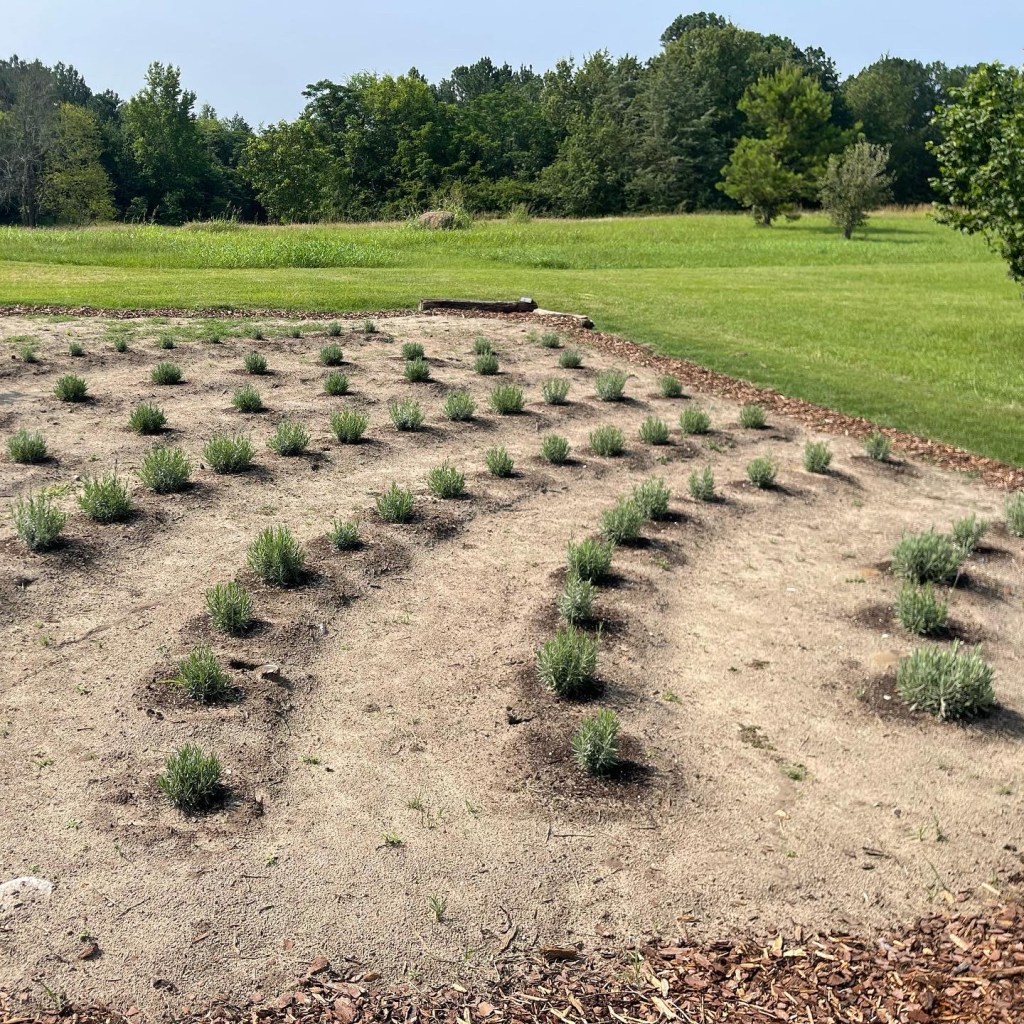
When she showed me her newly planted lavender bed, she said that lavender likes sandy soil with good drainage. She recommended a mix of 1 part sand, 1 part potting soil, & 1 part compost. She recommended to water daily at first & then wait a day, water, & then 2 days, water, & then 3 days, water, and so forth until established continuing to spread time out between waterings while watching the young plant for any stress. In the Southeast, you will want to look for varieties that tolerate heat and humidity of course. She likes the varieties “Grosso” and “Lavendula X Intermedia” (aka: Provence) for cuttings & “Lavendula Angustifolia” aka: English Lavender for culinary use.
We grabbed a refreshing cool drink of Hibiscus Tea with lavender simple syrup and went out to harvest some lavender from her established hybrid lavender plants which were buzzing with busy bees. Amy showed us how to harvest, focusing only on stalks with larger flower bud heads and cutting the stem low, but where it was still green. If you cut down into the woody area, it will not continue to grow stalks from that area.
Workshop on how to make your own bundles to dry
We sat down to make bundles of our lavender to dry and a little vase to fill with culinary herbs Amy had collected while we walked and talked earlier on the garden tour. We were then treated to a nice lunch under two 100 year old pecans. The shade was lovely and the spread was beautiful and tasty as well!
Rosemary and lavender bundles to dry and a sweet little culinary herb bouquet to take home.Rolls, chicken salad, pimento cheese, garden-to-table cucumber, and grape salad with yogurt, pecans and brown sugar (YUM!)Strawberry cup cake on pretty floral plates.
My daughter and I had quite the laugh when one of the farm cats jumped up onto the table to try and sample our chicken salad. Another farm cat came along and soon the two were vying to compete for the food they knew was close by. Lunch and entertainment! LOL
Tips for Drying Lavender for Herbal Use in Tinctures, Salves, Sachets, and More
When drying herbs, you can make bunches to hang and secure them with a rubber band, but don’t make too large or you may get fungal issues in the center of the bunch. Your lavender needs warm air circulating around it to dry well. Amy also had some screens positioned to dry other herbs she was growing in her garden in her workshop and store area. If you use screens, just make sure you don’t use metal screens, but nylon. If you have a dehydrator (how I dry mine) lay out (flowers still on stem, without overlapping) & keep heat circulating 90°-100°F for 24-48 hrs until stem is crispy dry. Defoliate (strip) petals from stem and store in an amber jar with a lid that seals in a cool dry place until you are ready to use.
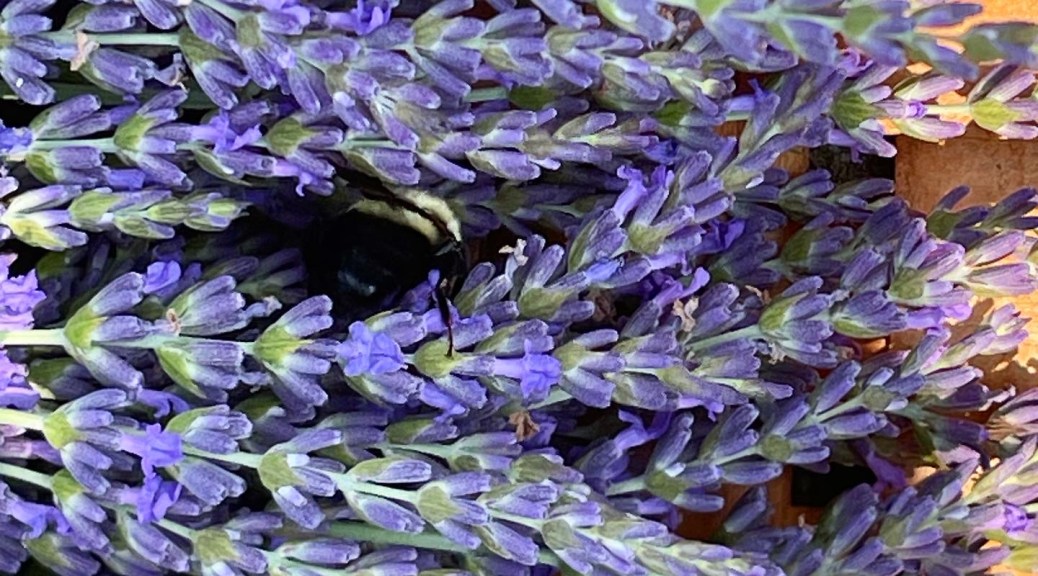
Can you see the bee?Gift shop with fresh herbal teas to drink and cool off while you enjoy the farm.
Ideas for using culinary lavender
Amy also kindly shared some ideas for using lavender to enjoy with food:
Make a lavender simple syrup and add to most any beverage (teas, juice, cocktails, or sparkling water). If you’re wanting to try making your own lavender simple syrup, you can grab the recipe here.
Make infused sugar or infused salt (add several sprigs to a jar of sugar and let it sit up to six (6) weeks
Add lavender buds to your scrambled eggs or omelette while cooking (eggs and lavender pair well together).
Add to salad dressings and marinades.
Cook in lavender when making jams and jelly.
Decorate tops of cakes, cupcakes, desserts.
Bake with lavender (for most recipes, add about 1 Tbsp ground lavender to recipe.)
Roast chicken or port with a little lavender (and rosemary , too!)
Lavender Simple Syrup Flower Essence
I first enjoyed this at White Hill Farm in Dearborn, GA with Hibiscus Tea. The owner, Amy, shared this recipe with me and it was so fun to try I wanted to share with you!
Way to Heat Purified Water
Container with lid to store simple syrup in fridge when not using
Mixing Spoon
1-cup measuring cup
1 cup sugar
1 cup purified filtered water
8 or 10 sprigs dried lavender
Add boiling water to sugar in a a 2-cup Pyrex measuring cup and stir (or boil together in small saucepan on stove.)
When sure is dissolved, break apart lavender stems and add to sugar mixture.
Let steep for 30-60 minutes until desired taste, then strain out lavender.
Lavender syrup will keep in the refrigerator for about 3 weeks.
Lavender Lemonade: 1 cup lavender simple syrup (recipe above) 1 cup fresh squeezed lemon juice from 4-6 lemons 4 cups of filtered cold water
Combine all ingredients and taste. Add more syrup or juice if desired. Serve chilled or over ice.
Beverage ideas for herbal syrups:
Make a simple syrup using fresh mint, rosemary, basil, thyme, organic rose petals, hibiscus, or your favorite herb.
Add to unsweetened black or green tea.
Add fresh fruit juice and syrup to unflavored carbonated water (such as La Croix, Perrier, or soda water) to create your own bubbly sodas.
flower essence, lavender, simple syrup, syrup
If you’re interested in visiting Amy’s lavender farm, White Hills Farm, and staying in Thomson, you can enjoy the same package we did by using this link. Be sure to let them know you heard about it from Grow Your Health Gardening! (We don’t get a kick back, but it helps them know how to best serve future interested visitors.)
Thomson, Georgia has some good local eateries
A few other highlights from the trip included eating at a barbecue place called Pigg-ah-boo’s. It was recommended by Amy whose husband liked to smoke meat as well. My husband makes amazing barbecue as well, so we love to try out other barbecue places while traveling. To be honest, when we first arrived I had my doubts. There was no one else there and the place lacked ambiance. But we sat down and soon others started to arrive to get food as well. Everything tasted fantastic!
Pigg-ah-Boos was worth the stop if you like good barbecue.
The next day we tried Fernanda’s Grill and Pizzeria because it was one of the few restaurants opened (and was also one of the recommendations Amy gave us. The food there did not disappoint either and we ate well! The above pizza pictured is called the “Fahgetaboutit” and was super filling. The service was good and we didn’t have to wait long to get our food on Father’s Day even though the place was busy.
Travel midweek and call ahead for tour of Georgia’s first all-robotic Dairy Farm
We tried to check out the first robotic dairy farm in Georgia, but you have to organize a tour in advance and minimum is $100 for them to even give a tour. They only tour through the week, so if you’re a week-end traveler, skip this option or call in advance to make arrangements.
Fun shopping, but shop before 3 pm on Saturday!
We did find some cool vintage stuff at a place called Aunt Tique and Uncle Junks. It was so nice that they stayed open until 6 pm as most of the shops in town closed at 3 pm and were closed on Sunday. I picked myself up a few vintage medicine glass pieces to put herbal tinctures in at a later date.
Aunt Tique and Uncle Junks is worth the stop (closed Sundays).Check out E.T. hanging out in the VW in front of the store.Vintage goods high and low, but easy to shop. We found some treasures!
All in all, a fun week-end getaway. If we were to go again, I would research places on our interest list and when they are open/closed because we missed out on some neat looking gift shops because of our Saturday morning plans and didn’t realize most of the stores shut down at 3 pm on a Saturday and then are closed on Sunday. I also wish the hotel’s pool had been open, because our kids would have really enjoyed swimming. But we were glad to know that fishing wasn’t too far away, because the guys really were able to relax lakeside for a few hours each day which was nice. I also loved the farm tour and am planning where I can plant some of the cultivars that Amy recommended. I would eat at the same places again and try to squeeze in a few more local restaurants instead of opting for familiar chain eats near the hotel our first night.
Part of the fun of traveling is trying new foods and seeing new things, so getting our game plan ahead of time would be helpful. If you want to visit Thomson, GA, check out this page they have created for out-of-towners visiting. If you live in the Atlanta area, be sure to check it out sometime! And don’t forget to plant some lavender this year!
The Tower Garden has been recently featured on “Daily Mom” in their list of “unique gardening equipment, gear, and fall decoration for outside.” [Link below] Although we run our Tower Gardens from April to October outdoors, these hydroponic systems really shine indoors where you can grow food 24 hours a day, 7 days a week using built-in automation through timers that turn on the pump and light without you having to do anything once it’s been set up to run.
My husband and I see our Tower Gardens as an investment — it is a gardening tool that helps us grow food easily and effectively. As a busy mom of five children running a growing operation, I like any time saving tools I can utilize and my hydroponic Tower Gardens have MORE THAN paid for themselves over the years.
I’m not only saving time, but also a valuable resource: water. Research has shown that hydroponic systems like the Tower Garden grow food 3x faster, 3x bigger all while only using 98% of the water used in traditional soil-based growing systems. I can grow my greens in 2% of the water it would normally take to grow greens in soil! And what’s more, I have less to clean and wash when it comes to harvesting food, because my plants are not in contact with soil which can harbor bacteria.
Lastly, I love that I know what is going into and onto our food. I pick it fresh and eat it the same day for maximum nutrition. Our food is grown with nutrients and minerals mined from the earth and put into a water-soluble form for plants to utilize and grow.
And if I’m not able to eat everything we’ve grown, no problem! We go from harvest to our Harvest Right freeze dryer or dehydrator immediately capturing and sealing in all that nutrition for later use.
Yet another outbreak due to tainted lettuce salad in the first few months of 2022. At latest report, 17 have been sickened across 13 states and two unfortunate deaths in a recent listeria outbreak according to the U.S. Centers for Disease Control and Prevention (CDC).
The salads, which were recalled by Dole in December and are currently under an active investigation by the CDC, include a variety of different mixes. They were sold in either bags or plastic clamshell packaging, according to the agency, which said they include Caesar salads, mixed greens, and garden salads.
The salads that were tainted are sold under several different brand names such as Ahold, Dole, HEB, Kroger, Lidl, Little Salad Bar, Marketside, Naturally Better, Nature’s Promise, President’s Choice, and Simply Nature, the alert said.
The recalled salads have “Best if used by” dates between Nov. 30, 2021, and Jan. 9, 2022, the CDC said. They also have lot codes that start with the letters “B,” “N,” “W” or “Y.”
For those who suspect they may have the salad in their refrigerators, the CDC recommends to “throw them away or return them to where you bought them.” The agency further recommends that people clean their refrigerators, surfaces, or items that might have touched the recalled products as listeria can survive “in the refrigerator and can easily spread to other foods and surfaces.” If you suspect you have this in your refrigerator or have consumed this product, please reach out to the CDC immediately.
This is not the only incident. The CDC said that it is also investigating another listeria outbreak connected to Fresh Express packaged salads, which occurred in December of last year and led to 10 hospitalizations and one death. That recall includes use-by dates with the product codes Z324 through Z350. Affected brands include Bowl & Basket, Giant Eagle, Fresh Express, Marketside, O Organics, Little Salad Bar, Signature Farms, Simply Nature, Weis Fresh from the Field, and Wellsley Farms, said the agency.
According to the Mayo Clinic, a “listeria infection is a food borne bacterial illness that can be very serious for pregnant women, people older than 65 and people with weakened immune systems.” And that “healthy people rarely become ill from listeria infection, but the disease can be fatal to unborn babies, newborns and people with weakened immune systems.” Symptoms include fever, muscle aches, nausea, chills, diarrhea, while more serious symptoms can include stiff neck, headache, convulsions, and a loss of balance, the clinic’s website says. “Symptoms might begin a few days after you’ve eaten contaminated food, but it can take 30 days or more before the first signs and symptoms of infection begin.”
This is not the first time outbreaks that result in the loss of life have been cause by those eating bagged salad or greens purchased from big box retailers. In the busyness of life, we trade food security and nutrition for convenience.
I didn’t learn until about five years ago, that most of our lettuce comes from Salinas, California. For those of us living on the East Coast, that means our greens have to travel approximately 3,000 miles which takes on average about 10 days to go from field to our table. When you think about nutrients lost for every day post-harvest, we are simply eating old food.
Here’s the thing… it doesn’t need to be this way. With changing a few habits, we can have greens at home in a number of ways, but the easiest by far that I have found is growing greens in my hydroponic / aeroponic growing system, the Tower Garden. I can start seeds for greens every couple of weeks and have a constant supply of greens, right in my home, 365 days a year. And when I harvest the greens, I can simply go from my vertical garden growing system to my table within literally minutes with a quick wash and spin dry if I wanted to do so! (Normally I harvest my greens in the morning when they are at their peak nutrition and the chill them after cleaning the leaves and spinning the leaves dry before fixing a salad.)
I’ve heard it time and time again when people balk at the price of a hydroponic / aeroponic Tower Garden. I don’t blame them. I know I did the same thing at first. And then my husband had a heart attack and suddenly the price of that tool to grow food seemed to PALE in comparison to the medical bills that piled up and the new life of treatment we faced post-heart attack.
I remember, one of THE BEST decisions I made following his heart attack was to purchase three Tower Garden vertical garden growing systems (we got the three Family Pack). We opted for the payment plan and paid on them for only a year. We looked at it as if we were paying for insurance but instead investing in the health of our family. Boy were we right! Now, we are going into our fifth year of growing food in these full- paid-for vertical garden growing systems. They have easily paid for themselves over and again; I cannot begin to describe how many fresh greens we have eaten off of these Tower Gardens!
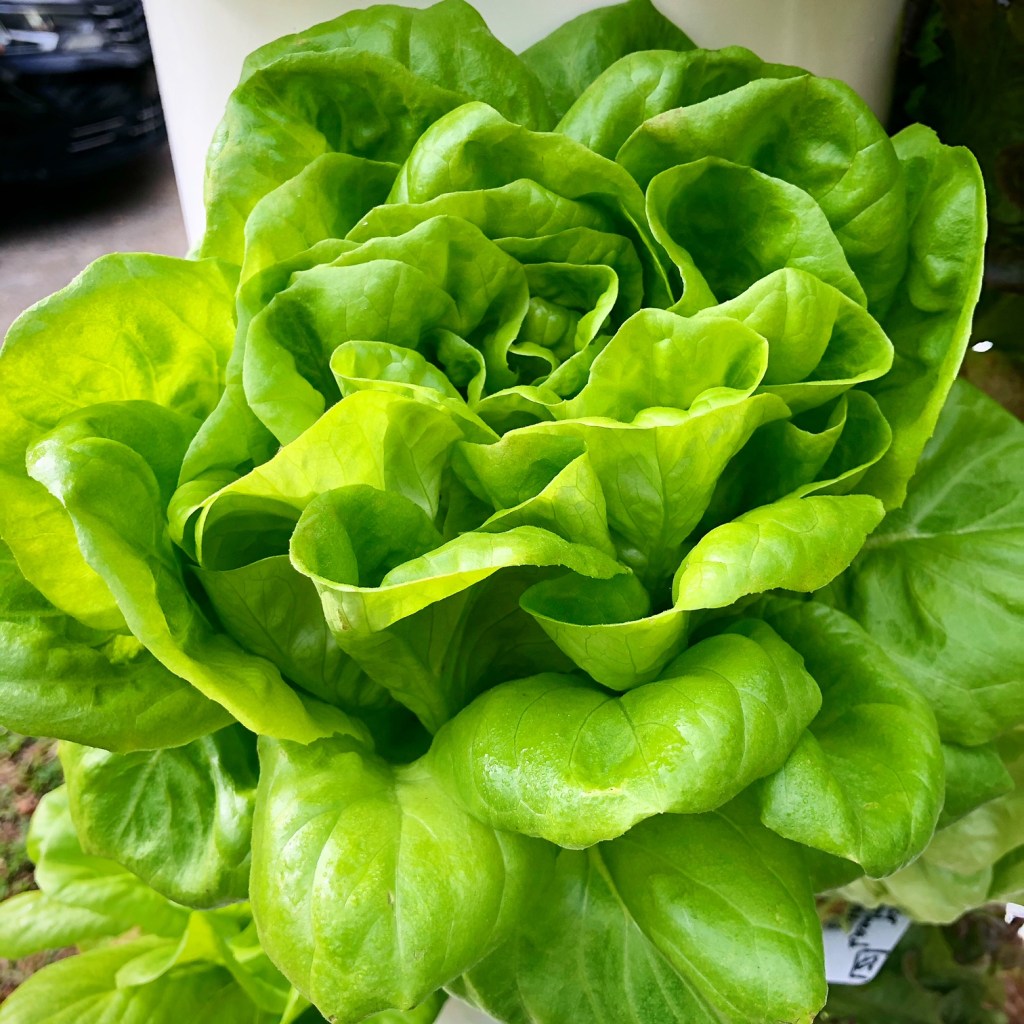
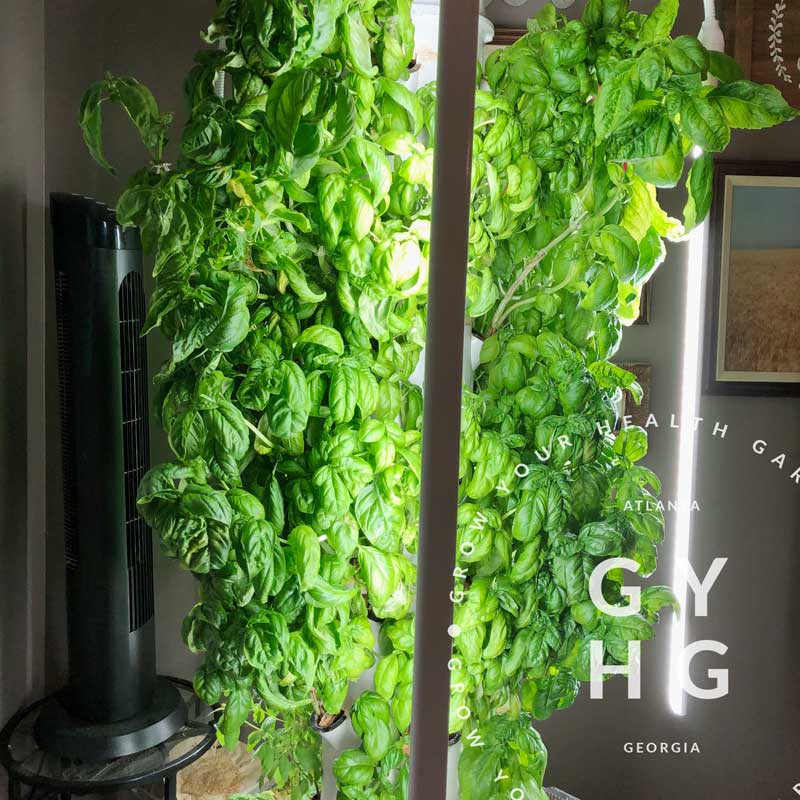
We learned in growing our own food hydroponically, that our Rainbow Swiss Chard roots were the same color as the stalks! How cool is that?!Bibb Lettuce greens growing on hydroponic Tower Garden.Spinach Leaf from spinach plant grown on the Tower Garden vertical garden hydroponic aeroponic growing system,Basil growing on indoor hydroponic Tower Garden growing system.
If you aren’t willing or able to invest in a growing system like this, at least start with something smaller, like an Aerogarden that can sit on your kitchen counter. There are outdoor options you can cover as well if you prefer that use soil, but I’ve found that using a growing system that circulates the same water and nutrients not only saves water, but it frees me up from having to babysit watering something growing in soil every day. I’m a busy homeschooling mom of five — I need things automated as much as possible. I simply add checking on the Towers 1 – 2x a week to my work flow at home and smile big when I have the food and herbs at my fingertips when it comes time to make dinner. You can learn more here if you’re interested or send us a message and we will reach out to you to answer any questions.
And if you’re buying salad kits…. Stop. Stop trading what seems to be a convenience for what you think is healthy. They are not healthy. You’re eating old food. Unless it says right on the packaging that it was grown locally, do not buy it. Grow it at home. And be careful of anything that had to be processed (ie: cut and assembled). You’re putting a lot of faith into someone else.
Learn how easy it is to grow your own greens at home. Let us help you on that path of discovery. Just ask in the comments below and we will be happy to answer any question or click on the pictures below which will take you to further information.
Both of these systems can grow food indoors. The Flex system on the right can ADD additional sections on top and grow higher (more food per square foot) with the proper pump. Be sure to reach out to us at hello@growyourhealthgardening and we’d be happy to answer any questions about growing food the EASY WAY hydroponically in a vertical garden like the Tower Garden growing system.
Full disclosure: I am a Tower Garden Rep (Erin Castillo). Helping families lead healthier lives using modern tools and hydroponic / aeroponic organic growing methods.
{We shared this info with our followers via email at the end of December, but wanted to share on Grow Your Health Gardening as well. If you want to get our emails (where we share information first on new releases and other tips first) you can do that here: https://store.growyourhealthgardening.com (page down just a little bit and you’ll see the spot to enter your email.)}
The results are in! Last season (2021) we counted and weighed every tomato that came off the vine and was harvested. Totals reflect equal number of plants per variety. If you’re looking for varieties that produce a multitude of blossoms and tomatoes, then this is YOUR LIST to grab. We will also include links to each tomato variety if you’re interested in getting homegrown seed grown using organic methods. All of this tomatoes were grown hydroponically meaning the tomato plants received the perfect pH level and ideal nutrients throughout the season.
If you have any questions, feel free to ask in the comments below. (But remember, our data is propiertary and we cannot share specific weights.) So here we go… ready? And the top ten biggest producers out of 75+ varieties (by weight) are…
It was originally bred by Tom Wagner and is a determinate variety. It only gets a couple of feet tall and needs only a little support making it ideal for containers and small space gardening. It grows nicely in 5 gallon felt containers or Bato Bucket systems and is a heavy producer — boy does it produce blooms! Wowza! If you plant this variety every two weeks in the first part of the growing season, you will have a bushel load of tomatoes that can be used for slicing, salsa, salad, sandwiches, canning, drying, Fried Green Tomatoes… you name it! This is one I can’t wait to grow again!
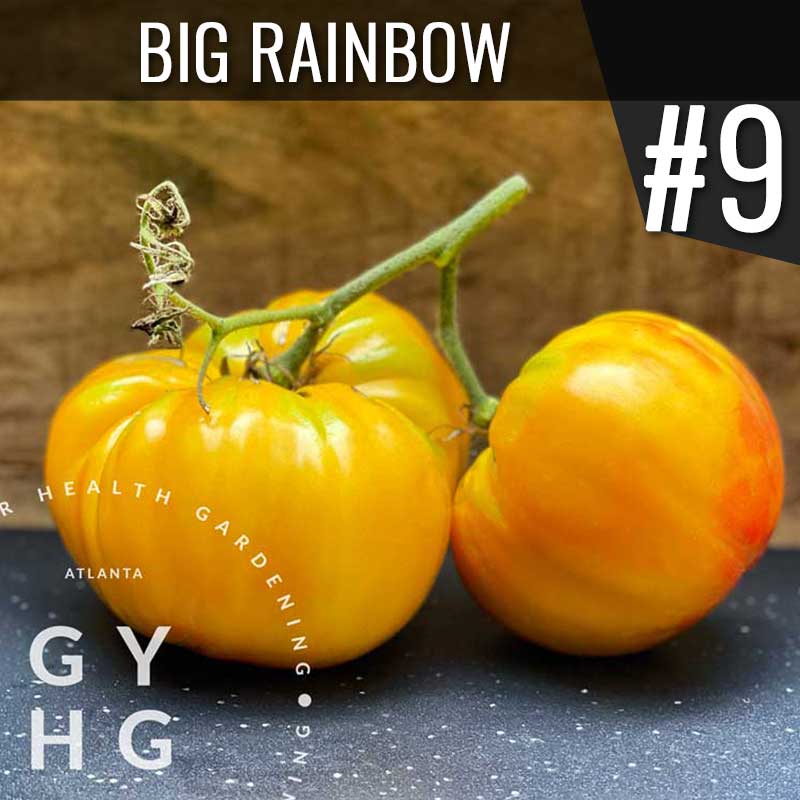
We were drawn to this tomato for it’s beautiful coloration when sliced open! Big Rainbow Tomato is a beautiful bi-color slicer tomato variety with early tomatoes weighing 2+ pounds with very little cat facing or deformities. It has good resistance to foliar disease and is an indeterminate.
Big Rainbow Tomato variety will ripen with color shades showing green on the should, yellow in the center, and red towards the bottom. When cut open, it will have bi-color shading of yellow and red making it a beautiful slice on the plate or sandwich. It has more flesh than seed ratio, so also serves well for using to make sauce.
We have adapted this seed to grow in a hydroponic system using organic methods and so even though it will grow in soil just fine, it is especially suited for hydroponic home growers using a Tower Garden, Bato Bucket system, or the Farmstand.
Thornburn’s Terra Cotta Heirloom Tomato is a joy to grow! Not only does it taste wonderful, but it’s color looks beautiful mixed in with other sliced standard red tomatoes. It’s outer skin and inside flesh of the tomato has a most unique color — it’s a mix of a chartreuse green and terra cotta — some call it a honey-brown shade, but our trials seemed to be more colorful than that.
If you especially love history, you’ll want to grow this tomato to preserve the seed for future generations because it is now 129 years old! It was originally introduced in Thornburn’s 1893 Seed Catalog. This is one easy slicer you won’t find in the grocery store aisle and will want to try!
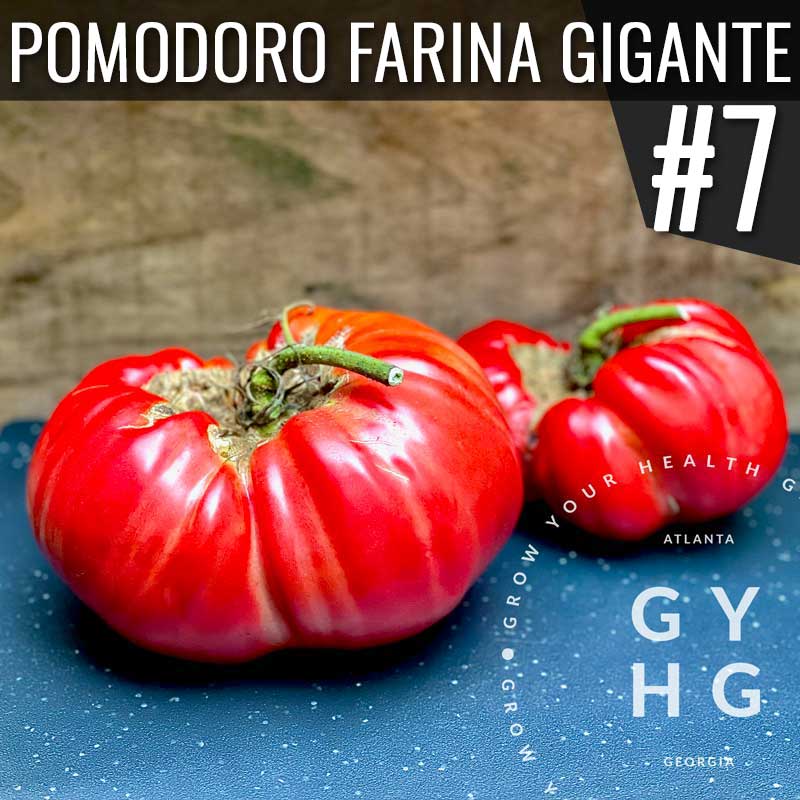
In all fairness to Pomodoro Farina Gigante Tomato, we were pruning this plant to get an exceptionally large tomato, so the overall weight for production may have been affected as it didn’t put out as many blossoms as it would have normally produced. With that said, this cultivar still weighed in making the Top 10 and is definitely a BIG TASTY classically robust Italian tomato!
This line of Pomodoro Farina Gigante Tomato seed DNA comes from the work of Mario Quattrocchi from Cuneo, Italy and originally from Remo Farina, a retired truck driver originally from Bleggio, Italy. Mr. Farina holds the record for the largest tomato in Italy and worked tirelessly for years to acheive his record breaking tomato. Our trials produced a 2 pound, 6 ounce tomato and others that followed ranged from 1.5-2 pounds. If you want to grow a large tomato, then this variety is the one to try!
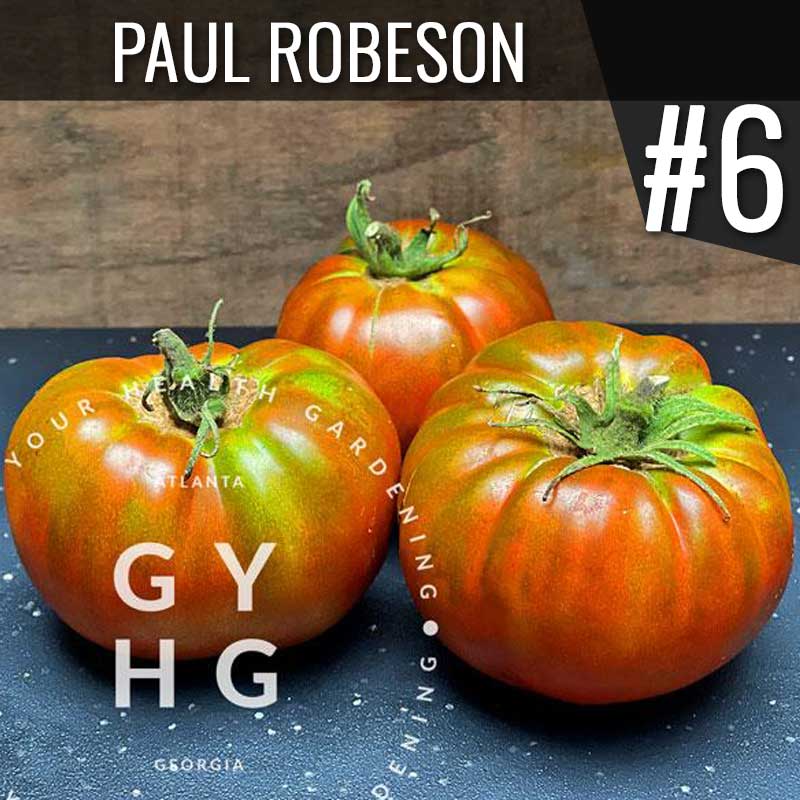
#6 MOST PRODUCTIVE 2021 SLICER TOMATO VARIETY: PAUL ROBESON HEIRLOOM TOMATO
Paul Robeson Heirloom Tomato is a nice slicer variety with a low seed count making it ideal for BLT sandwiches or it can even be used for making tomato paste. It has less acidity than traditional past varieties and a mild sweetness to it (though not as sweet as Cherokee Purple in our opinion). If you love Cherokee Purple, then you’ll enjoy this very similar, but more productive tomato variety. (At least grow the two varieties side-by-side and decide for yourself which one you like the best and share your opinion in the comments below.) Want to learn more about who Paul Robeson was in history? Click here
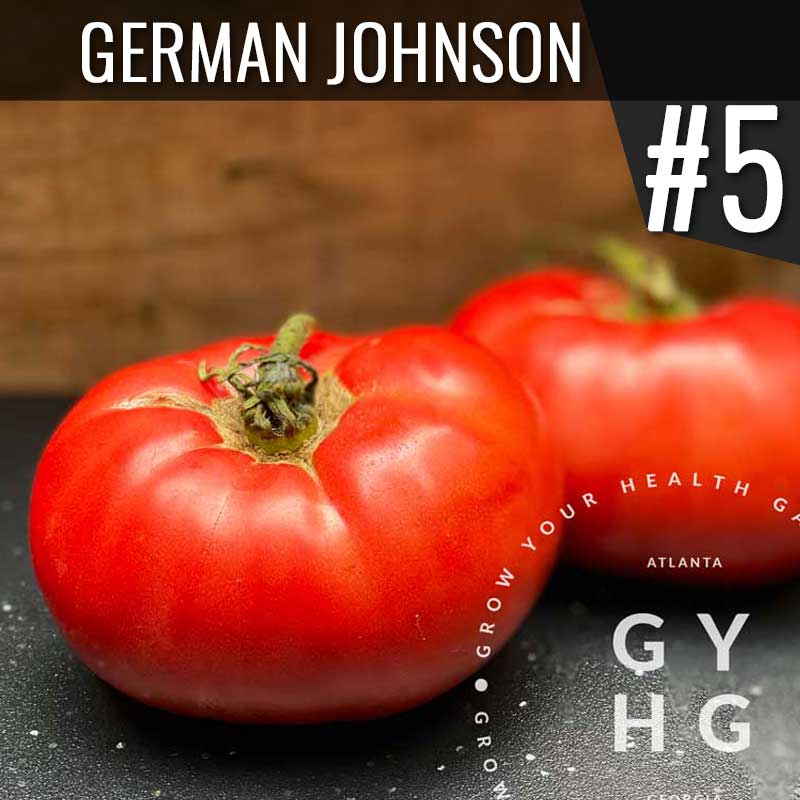
German Johnson Heirloom Tomato is a highly productive and excellent tasting pink heirloom. It is slightly smaller than a Brandywine and it has a deep acidic classic tomato flavor. It is a gorgeous tomato on and off the vine! This is a regular-leaf strain which can tend to come in earlier and is more productive than the potato-leaf strain. Can be used as a slicer or as a paste tomato. Very versatile and one of our favorites from this past growing season!
Nostrano Grasso Italian Heirloom Tomato is a very rare heirloom from Italy and mainly unheard of in the United States. It produces medium-sized tomatoes and is duo-purposed as a smaller slicer, but also a great sauce tomato. It has superb tomato flavor with a hint of sweetness. It just kept pumping out the tomatoes and didn’t get flower drop even in higher Hotlanta summer temps here in the Southeast. If you’re looking for authentic Italian flavor and a good producer, this is your tomato! Such a pretty tomato on the vine and on the plate!
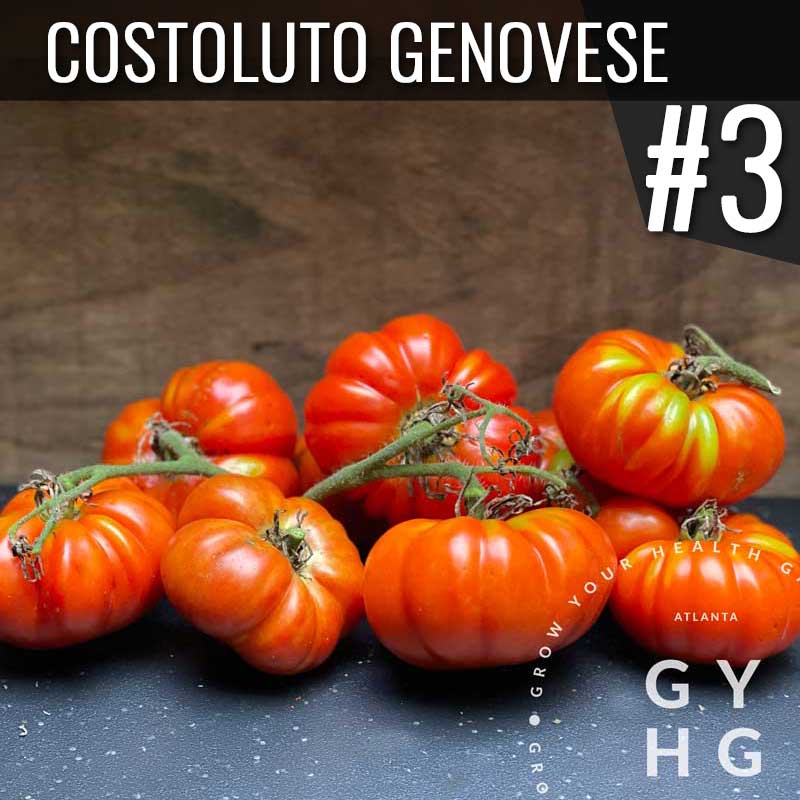
This variety pleasantly surprised us as well with it’s consistent production and final weigh-in totals. Costoluto Genovese Italian Heirloom Tomato is popular with chefs and a standard in Italy for both eating and preserving and we can see why! It has beautiful ruffled ribbing, so when it’s sliced, it looks pretty on the plate. Classic intense Italian tomato flavors. It was productive all season long no matter the temp. Definitely a keeper!
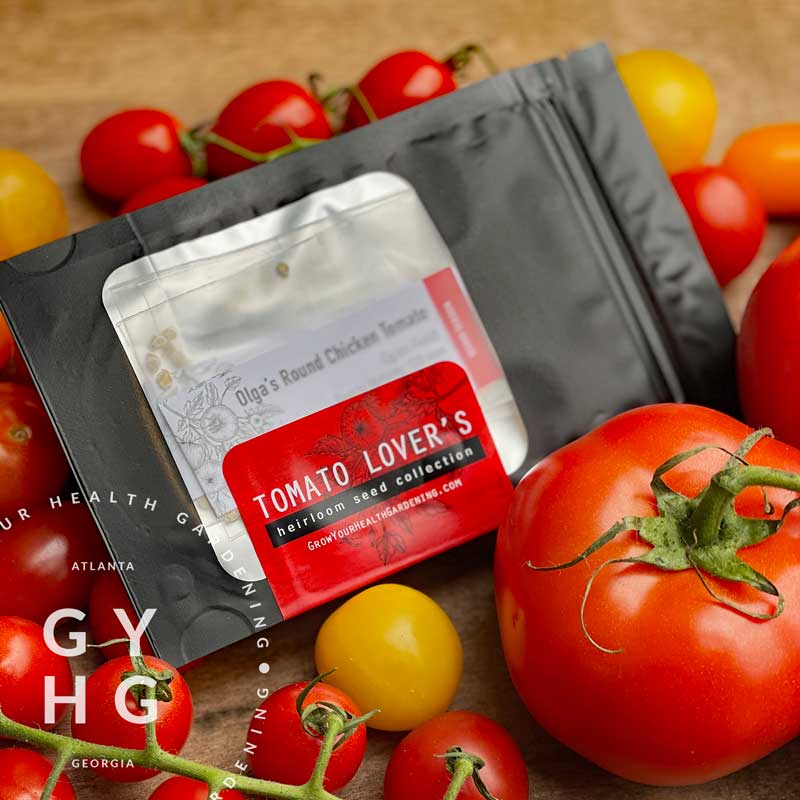
Olga’s Round Chicken Tomato is a heavy producer of almost perfectly round globe-shaped tennis-ball sized tomatoes. Not only does this tomato variety have a funny name (which truth be told is what drew us to explore and grow it), but it’s also super tasty and looks great diced in salsa or sliced on a sandwich!
I can see why Brandywine cultivars are a favorite among many tomato grower enthusiasts! They consistently produce big slicers through high heat when other cultivars wane. Apricot Brandywine Heirloom Tomato is a wonderful yellow-orange beefsteak type of slicing heirloom tomato. It has a leaf that mimics a potato leaf and produces beautiful apricot-colored tomatoes that weight a pound or so. This variety is perfect for sandwiches and has a fantastic aroma as well! It’s a gorgeous and tasty tomato that produces all season long. Check out what the inside of this tomato looks like in the video below:
If only we could also let you taste it! If you want a lot of big juicy tomatoes, this is one to try!
And that’s how the slicer-type tomato trials went last growing season! We will tuck away this data and refer back to as we continue to grow out and adapt other cultivars in growing seasons to come.
If you like trying unique tomatoes you can’t find in any grocery store or Farmer’s Market, we’ve put together a collection and discounted it for our customers. Be sure to check out “The Tomato Lovers” Collection and as well as “Erin’s Top Picks” in the shop! Which new variety will you choose to grow this coming year?
Grab several varieties of heirloom and open source tomato cultivars at a discounted price compared to purchasing individually with our Grow Your Health Gardening Tomato Lover’s Heirloom Seed Collection pack.
• The key to giving your body better nutrition is to grow your own food. — You will be able to eat what you grow shortly after harvest, thereby getting the highest level of nutrient that the plant can provide because the plant is allowed to grow to full maturity where nutrients will be at a peak AND you will be able to consume it shortly after harvest. — You have control over how your food is grown meaning soil health, hydroponics, and anything applied to the plant to control pest pressure or enhance nutrition profile in plant like beneficial biological foliar tea applications. — You will benefit not only physically, but mentally, emotionally and spiritually from being more connected to your food and outdoors.
• If you’ve never grown your own food, taking that first step can feel overwhelming. Begin by just choosing to focus on how to grow a food that you eat already and taking a moment to think about why you are motivated to make the effort.
• A simple and very doable approach to getting started growing your own food is to simply ask one question, “What one new thing can I learn to grow this year?”
The key to moving to better nutrition for your body is to grow your own food. That’s how my journey began. What did I do? I simply became curious and had an attitude to learn — and I picked just one plant to learn about. I deep dove into learning everything I could about that one plant and what it needed to grow. Single focused. One simple step. A willingness to change and grow through gardening.
Background Image credit: Kim Kight Moda Fabric Nov 2021 Release
Here’s how you can make a BIG difference this year in your health by just learning to grow one new plant:
Step 1: Consider healthy grown food choices you are already enjoying.
You’re more likely to eat what you grow and if it’s already something you’re familiar. Research has even shown this to be true with children — children are more likely to eat what they have grown. Why would we be any different? 😉
For example, I like to eat Kale. I noticed that Kale was on EWG’s (Environmental Working Group’s) Dirty Dozen List. I didn’t want to give up eating kale simply because it was often sprayed by those growing it and wanted to reduce the amount of chemicals I was putting into my body. I also found that my kids like the cheesy kale chips at the store, but my pocket book felt the pain every time I had to purchase that in bulk. The best solution? Learn to grow it.
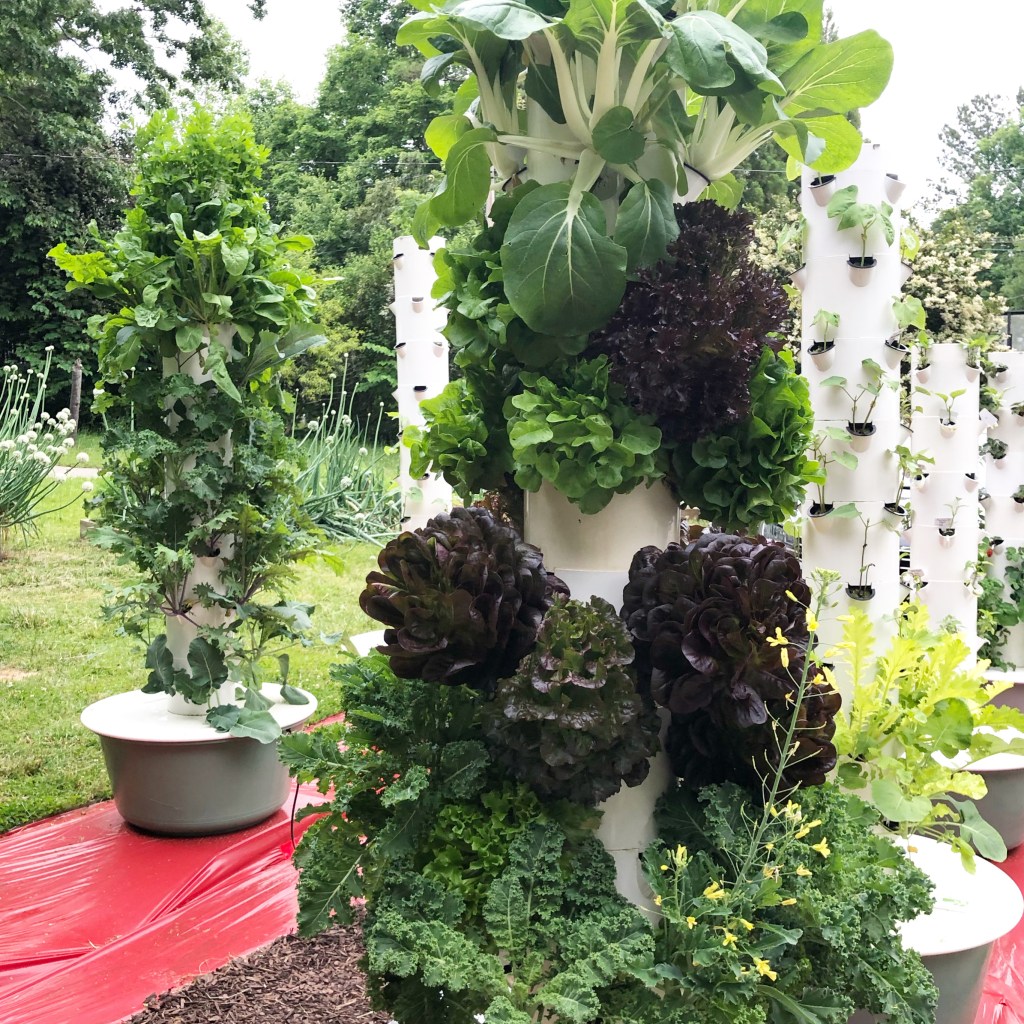
Tower Garden growing hyroponic lettuce, kale and bok choy. To learn more visit: erincastillo.towergarden.com
Tip: If you’re new to growing Spinach and gardening altogether, I recommend that you don’t pick spinach as your first plant to try growing from seed. Instead, purchase a start and grow it from that stage or read our article on how to start spinach from seed.
Background Image credit: Kim Kight Moda Fabric Nov 2021 Release
Step 2: Learn everything you can about what the plant needs to grow.
Single-tasking has been proven to be THE BEST way to get something done. Keep it simple. Don’t over-complicate things. Just choose one thing and learn it well. Focusing on learning one new plant will set you up for success and lead to better nutrition for your body!
We are so blessed to live in an age where we have so much information at our fingertips with a simple search. Take advantage of this and devote at least 15 focused non-distracted minutes a day to look-up details about the plant you’re wanting to learn how to grow. Record what you learn on a sheet a paper and put it in a 3-Ring Binder. This becomes a handy-reference in seasons to come as you add other plants to your ever growing notebook.
You’ll find that after a couple of growing seasons, you’re able to add more than one plant to your ever-growing “new plants I’m curious about” list. And you’ll be able tackle more because once you know a plant, you can grow a different similar variety with ease because you’ve already studied that plant group.
“Take advantage of this and devote at least 15 focused non-distracted minutes a day to look-up details about the plant you’re wanting to learn how to grow. Record what you learn on a sheet a paper and put it in a 3-Ring Binder” — Erin Castillo, Owner of Grow Your Health Gardening
Tomato Lover’s Heirloom Tomato Seed Collection by Grow Your Health Gardening Seed Co. is our top pics for anyone who wants to grow tomatoes not found in the big box chain or grocery store. A true culinary delight.
Let curiosity guide your research. Ask questions like:
What temperature does this plant like to grow in: Cool or Warm? Knowing the temperature preference of a specific plant cultivar will tell you what time of year to start growing that plant. For example, kale likes to grow when it is cooler. Okay. How cool? Is there a certain range of temperature it prefers? Okay. We find that it likes 70ºF-80ºF, but some varieties like Lucinato (Dinosaur Kale), Dwarf Siberian, Vates Blue Scotch, Premier, White Russian, and Red Russian can tolerate SOIL TEMPS as low as 20ºF. I can look up those temperature ranges for the area I live in and look to see about when those temperatures are occurring. Then, when I look at the days to maturity, I can use a calendar calculator and count backwards from that temperature range and I can get my seed start date. Not sure how to quickly find a date? Just do a keyword online search for “count days calculator” or pull out an actual monthly calendar and physically count the days backwards with your finger.
What sort of lighting requirements does the plant need? Most vegetables need 8-10 hours of full sun a day. Consider watching where you have a sunny patch for the longest hours in a day. This is going to be your growing area. Don’t have a sunny patch and just a lot of shade? No problem! Invest in an indoor growing system with grow lights where you can control the temperature and grow year round.
What is the ideal pH range your plant needs to take up nutrients? Your pH level plays a very important role in which nutrients a plant can access and use to fuel it. I’ve provided a chart (below) to illustrate which nutrients a plant can take up when it’s within the ideal pH range. Most plants need somewhere between 5.5 to 6.8. Leafy greens prefer the 6.0 pH to 6.5 pH range whereas tomatoes prefer between 6.0-6.8 pH. Notice how kale, which likes it between 6.0-7.0 pH, when soil or water in a hydroponic or aquaponic system is kept between this range will be able to access nutrients like Nitrogen, Phosphorus, Potassium, Sulfur, Calcium, Magnesium, Iron, Manganese, Boron, Copper and Zinc and Molybdenum. If you’re growing hydroponically, you can quickly and easily test pH levels with a pH meter like this. If you’re growing in soil, you can get a soil test from your local county extension office for around $10. You can also get a device like this that will get you fairly close. Remember, soil takes several months to adjust the pH level. Hydroponics and Aeroponics takes only a few hours with either pH up or pH down.
pH Absorption Chart shows which nutrients are available to a plant based on pH range.
Heirloom Beans are a fun way of exploring a healthy and high protein food group. There are so many different types of beans (bush beans, pole beans, runner beans, etc.) that the options are endless in enjoying new types of beans you can’t find in the grocery store. Check out our line of heirloom beans at https://store.growyourhealthgardening.com
What sort of nutrients does my plant require? If you’re working in soil, it will be helpful to understand your soil food web and how micro-organisms and beneficial bacteria within the soil work together to help replenish nutrients in the soil for the plant to access. If you’re working in hydroponics or aquaponics, you’ll want to purchase a TDS meter and a well-rounded nutrient like this Mineral Blend. When you go to add your nutrients, simply keep your PPM levels within the ideal range the plant prefers. You can find a fantastic hydroponic cheat sheethere that we’ve created for your convenience.
How long does it take for my plant to grow? Knowing this tidbit of information helps you figure out when to start growing your desired plant and calculating days to ensure you can get your plant to harvest stage. For example, I know that kale takes about two months to go from seed to ready for harvest. Again, you can reference most of this information in a simple chart here.
How many should I plant to produce enough food for myself and my family? How does that fit in with the growing space that has enough lighting that I have to work with at home? Learning how big a plant gets and if it continues to grow after a harvest can help you understand what sort of return you’ll get from starting one plant and growing it out.
Are there any diseases or pests that may target the plant I intend to grow? Can I take any preventative measures that don’t require chemical applications? For example, kale can get hit by the army worm. The eggs are laid by pretty white butterflies on the underside of the kale leaf where their young can have an instant food source. By simply covering your food crop with a net before these butterflies show up, you can dramatically increase your success rate and achieve your goals in growing healthy food. And know that it’s perfectly fine to learn as you go… don’t feel that you have to have a handle on all of this before you begin. When something shows up, you can look up what it is and how to deal with it. It’s part of the learning process.
What can I do with what I grow? How can it be preserved? For example, if I have a lot of kale, I can dehydrate it and make cheesy kale chips to store in my pantry (which my kids love). I can freeze it and use it in morning smoothies. I can dehydrate it and use in soups for added nutrition. Thinking how you already use this food will help you anticipate and plan ahead when the plant is ready to harvest.
How will growing this benefit me? We are such a consumer culture that wants things ready in an instant. We have to break this cycle. We forget that there is joy to be found in the rhythm of being more connected to our food and the process of seeing something from beginning to end — from seed to harvest to table. There are intangible benefits to note, like getting more exercise and being outside in the sunshine and fresh air which produces Vitamin D in your body and (sleep chemical). It relaxes your body which reduces stress and cortisone levels giving your thyroid a break. Then there’s the actual nutritional benefits. What vitamins does the plant you intend to grow give to your body? How will those nutrients help you be healthier and stronger? Sitting down and focusing on these things and having them written down will motivate you to keep going when you encounter any challenges to overcome along the way.
Background Image credit: Kim Kight Moda Fabric Nov 2021 Release
Step 3: Reap the rewards. Bask in the benefits of your time and effort.
I just can’t describe how good it feels to have those you love, enjoy eating something that I grew. It feels good knowing I gave them the very best thing that they could eat and KNOW that it wasn’t sprayed or treated with any chemicals. One of the best feelings ever. I remember when I learned to grow basil and made pesto. My kids loved it! (And I did, too!) I loved that I could easily make it and put in the freezer for a quick week-night meal and that it was immune boosting. It’s the “new elderberry syrup” for improving our health. (Yes, basil is that healthy!)
Rosemary Lemon Chicken is a tasty dish and the flavors are more pronounced with freshly picked and harvested rosemary. Check your growing zone to see what rosemary varieties are frost-hardy in your area.
Rosemary harvested can be dehydrated and stored to add to any dish later on.
If your plant didn’t grow or produce like you thought it would, that’s okay, too! In our home, we know that not meeting our goal or objective doesn’t equate to failure. Failure is when you don’t even try. If you feel discouraged, pick up your bootstraps and realize you have already succeeded because you took that difficult first step when so many others wouldn’t even attempt it. You are further along than you were before you ever tried. We can learn from everything we do. And as you’ll see in growing plants, every plant has very specific needs that must be met in order for them to grow (which also may make you reconsider the whole antiquated evolution theory and how things just may have “coincidentally happened” … more on that another time… but I think you may discover that plants are more complex than just throwing a seed in the ground. They were designed with a purpose and need specific parameter to grow and thrive.)
Even the chickens can enjoy the fruits of our labor. Kale is a FANTASTIC healthy green (or purple in this case) to feed chickens in the winter. Here, we hang a wire basket and share some of the bounty with our girls knowing what they eat will benefit us as well when it comes time to enjoy the eggs they produce.
So remember, there are countless benefits to consider. Think about and write down how learning about that one plant has or will benefit you. When I consider my own journey, growing my own food has been more than just plants though…. I have gotten off the couch and out from behind my desk and computer (except for this moment of course as I write to you) and it gets me actively moving my body which is good for me. I love to wear earbuds and listen to music or Podcasts as I work, so it is a moment where I can step away from my life responsibilities and refuel my mind and spirit while accomplishing a gardening task like pruning, checking on water lines and levels, or checking for pests. Know that you’ll benefit as well in the same way; research tells us that those who garden are happier. I’m also getting a good dose of Vitamin D from that sunshine and producing melatonin which both help your immune system. I have a college degree and could work in any corporate setting, but I have purposely chosen this natural permiculture and hydroponic organic method of growing food, because it is healthier for me physically, mentally, and emotionally. Plus, it is something a can do with my children, teaching them how plants grow and why they should grow them. I am sowing into not only myself, but the next generation.
Background Image credit: Kim Kight Moda Fabric Nov 2021 Release
Step 4: Repeat.
After you’ve finished the growing cycle of your plant and have accessed how it went in your gardening journal, repeat the process the next season. Pick another type of plant you’re interested in learning more about and pursue it. But here’s the cool thing… because you have already learned how to grow that other plant, you can now choose another variety within that same plant group and grow it AND the new plant you’re interested in learning more about. As you repeat this process season after season, before you know it, you’re growing a whole slew of healthy plants and enjoying reaping the benefits!
Let us know which plant you’re curious about and plan on learning more this year in the comments below!
Happy growing,
Erin
Erin Castillo is the owner of Grow Your Health Gardening and Lead Grower of GYHG Seed Co. She is certified in hydroponics and growing food using organic methods. She believes that life is to be lived to the fullest.
Know that there shouldn’t be GMO seed available to consumers and is sold to producers only at this time, but you need to be aware of what is happening in our food supply chain as it could affect you in what you consume from the grocery store.
With genetically modified organisms (GMOs), we risk transforming our food into a patented commodity controlled by a few multinationals, and stripping farmers and consumers of their rights. GMOs are unreliable from a scientific point of view, inefficient in economic terms and unsustainable in an environmental analysis. Little is known about them from a health perspective and from a technical standpoint they are obsolete.
What are GMOs?
A GMO is an organism in which a gene belonging to one species is transferred to the DNA of another – for example a bacterium to a plant. This process cannot occur in nature through breeding or natural genetic cross over.
What aren’t they?
Supporters of GMOs would like to make consumers believe that they have always existed. In reality, they are intentionally confusing the genetic engineering that produces GMOs with other biotechnologies such as grafting, interbreeding, seed propagation, etc. These techniques, some of which are thousands of years old, actually underlie the fundamental developments made by agriculture and humanity itself. GMOs are born exclusively in laboratories; there is no way in which they can be created in nature.
Some stats on GMOs
14 million agriculturists across 25 nations plant genetically modified seeds on 134 million hectares. (2009 data).
Of the crops grown worldwide, GMOs represent 77% of the soya, 49% of cotton, 26% of corn and 21% of rapeseed. This is a clear sign of the great decrease in biodiversity on cultivated land.
In the first phase of GMO cultivation, between 1996 and 2005, they were used primarily across the Americas. Since 2006 however, the greatest growth has occurred in Asia and Africa.
GMOs have been around for 30 years, with the first GMO plant dating back to 1981. But after a great amount of research, in practice only four GMO plants are being used commercially – soya, cotton, corn and rapeseed – and only two characteristics have been integrated: tolerance to herbicides and resistance to insects.
1. GMOs don’t feed the world
99% of GMO crops are not destined for human food, but rather for animal feed and biofuels. Land dedicated to growing GMOs is being expanded at the expense of food production.
2. It is not true that GMOs are more productive
GMOs have not increased productivity. According to official data from the United States Department of Agriculture, there has been no recorded increase in the soya and corn yield following the introduction of GMOs to American agriculture.
3. GMOs do not reduce the use of chemical products
Genetically modified plants are resistant to specific herbicides. For example, Monsanto sells genetically modified corn seeds and also sells Roundup Ready, an extremely potent herbicide that is the only one able to be used with cultivation of this corn. However, using Roundup on the GMO fields doesn’t eliminate all of the weeds: some resist the herbicide and this resistance is strengthened with each generation. These weeds become problematic and new chemical products must be invented to deal with them.
According to the Environment Working Group (EWG) this is a problem and why they, as a ‘think tank’ to monitor the government’s role in managing this with our food system.
“Nearly all corn and soybeans in the U.S. – totaling more than 150 million acres – are genetically engineered to withstand glyphosate, the active ingredient in Monsanto’s Roundup. But over-reliance on glyphosate has led to the growth of “super weeds” that are resistant to the weed killer. Today, more than 60 million acres of U.S. farmland are infested with weeds resistant to glyphosate.
Because of this super weed problem, farmers are turning to a chemical cocktail of glyphosate and 2,4-D, a possibly cancer-causing herbicide linked to Parkinson’s disease and thyroid problems. The leading cancer researchers at the World Health Organization recently classified glyphosate alone as ‘probably carcinogenic to humans.'”
4. GMOs impoverish biodiversity
GMOs require larger areas of land and intensive monoculture cultivation to reduce production costs. This in turn means farmers are displaced from their land and cultures and traditional knowledge are lost. In fact, a team of researchers reviewed 34 years of USDA census data on every recorded crop species grown in U.S. counties and found a “steady decline in diversity in almost every food-growing part of the country.”
5. GMOs allow multinationals to control food
The multinational companies that patent and produce GMO seeds control the majority of the seed market and often also produce herbicides and fertilizers.
6. GMOs compromise food sovereignty for communities
How can organic, biodynamic and conventional farmers be sure that their crops haven’t been contaminated? The spread, even limited, of GMO cultivation in open fields will change the quality and state of our agriculture, taking away our freedom to choose what we cultivate and eat.
7. GMOs compromise freedom of choice for consumers
At the international level, labeling laws regarding GMO products lack uniformity and are insufficient. In Africa and Asia no legislation exists at all. In America there is no acknowledged difference between products containing GMOs and conventional products, and therefore it is not deemed necessary to inform consumers of the presence of GMOs. In Europe, producers are obliged to declare the presence of GMOs if in a quantity above 0.9%. However, also in Europe the majority of animal feeds commercially available contain genetically modified soya, but it is not obligatory to declare derivative products such as milk or meat on the label.
8. GMOs contribute to problems with bees and birds and an unbalanced ecosystem
In the last several years, numerous scientists have shown that neonicotinoids such as clothianidin are lethal for pollinators at agricultural field concentrations and are the most likely cause of colony collapse disorder in bees. Other studies show correlations between environmental neonics and the loss of birds, especially species that consume aquatic invertebrates.
Learn more about herbicide use and GMO crops below.
Documentary: When National Geographic Magazine reported that about 94% of the world’s vegetable seeds circa 1903 are now missing from the Earth, Taggart Siegel and Jon Betz promptly started work on a feature-length documentary about the seed saving movement. The product of their labor, Seed: the Untold Story
Know that there shouldn’t be GMO seed available to consumers and is sold to producers only at this time, but you need to be aware of what is happening in our food supply chain as it could affect you in what you consume from the grocery store.
When choosing seed for your garden, always look for seed providers that have made a commitment to biodiversity and preserving seed DNA as seed stewards through non-GMO open-source, non-patented and heirloom seed (like seed grown by Grow Your Health Gardening.) Not only will you play a key role in helping to maintain biodiversity within our food supply, but you’ll also enjoy the nutritional benefit of these fantastic seeds!
Shop seeds adapted to growing in the southeast (hot and humid zone 7B) in hydroponic systems at store.growyourhealthgardening.com
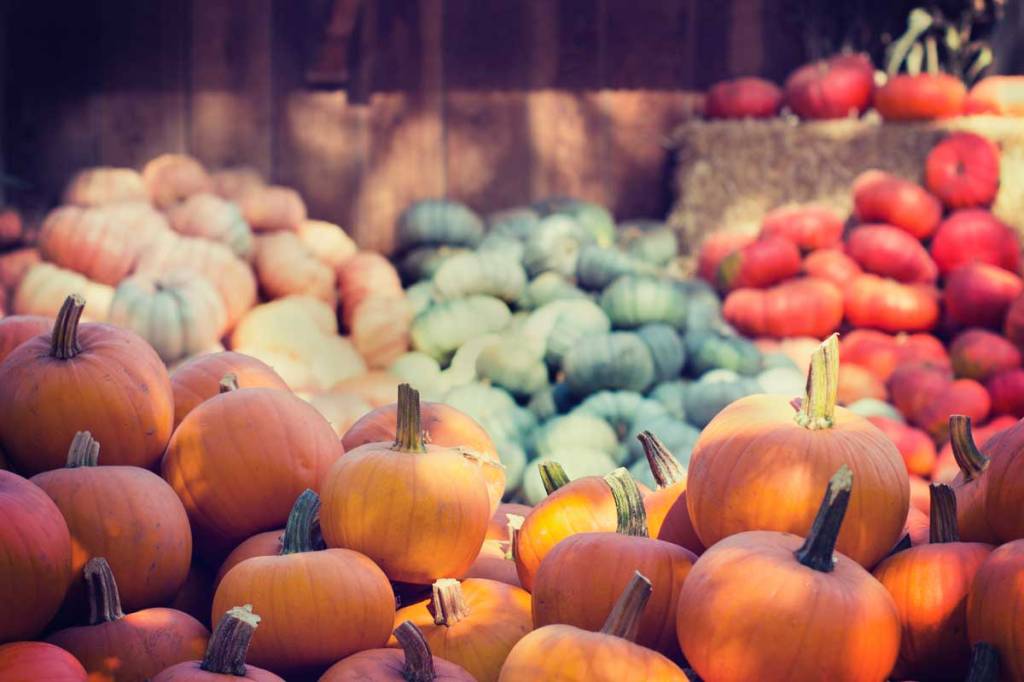
There are some fantastic faux pumpkins you can find at the craft store these days, but there’s nothing quite like having a fresh pumpkin for the front porch. If you’re heading out to your local pumpkin patch to pick out the perfect pumpkin, be sure to pick up three additional items from the store to help preserve your pumpkin (if you don’t have these already): bleach, dish soap and matte paint spray sealer.
When you return home with your freshly harvested pumpkin, before placing your treasure on the front porch, do this:
In a large sink or tub, prepare a mixture of bleach, water and dish soap: one (1) gallon of water, 2 tablespoons bleach, and a two drops of dish soap. Soak the pumpkin(s) in the mixture for 15-30 minutes.
Next, rinse the pumpkin(s) with cool water and dry completely.
After the pumpkins have dried all the way around them, take outside and give it a coat of spray matte sealer which will help preserve them even longer!
Have fun picking out your pumpkins! And be sure to share pics of your pumpkins with us on social media! Tag us at #gyhg or #growyourhealthgardening on Instagram, Gab, Google My Business, or Facebook.
While harvesting some kale this morning, this little guy hopped off of one of my leaves. If you’re a little squeamish of critters, keep in mind that tree frogs like these help eat aphids and other bugs that want to munch on your plants.
We also have green anoles (a type of small lizard) here in Zone 7 near Atlanta, Georgia. We used to spray 15 years ago and I noticed the anoles disappeared — we took away their food source!
Since then I have come to understand that these critters keep a balance to nature and show a healthy eco system is in place. Plus, my kids love to catch them! What helpers have you found in your garden?
Tips for Hydroponic, Aquaponic, and Soil-based Gardening Methods































 Grow Your Health Gardening